



Thank you Jennifer Butler, Julie Johnson Coulter, Danielle, Laura Stevenson, Regina, and many others for tuning into my live video with Diana Butler Bass and PRRI! Join me for my next live video in the app.

ICYMI, today Diana Butler Bass , Melissa Deckman , and I unpack the latest PRRI data showing Trump’s favorability in free fall across the political and religious landscape. The key findings are below, and you can find more details at PRRI here.
Over a year into the second Trump administration, the latest survey from PRRI finds that just 34% of Americans hold favorable views of Donald Trump, down from 41% just ahead of the 2024 presidential election, compared to six in ten Americans who hold unfavorable views of the president (62%).
Chart 1. Trump Favorability by Party Affiliation
Trump’s vulnerability becomes clear when his declining popularity is examined across a 7-part partisan scale. Notably, the sharpest drops in Trump favorability are among independents and soft Republicans.
Among “strong Republicans,” Trump’s favorability remains high and stable, standing at around 91%. However, support among less committed Republicans has weakened significantly, with favorability among “not very strong Republicans” dropping 7 points, from 70% to 63%.
Since the 2024 election, Trump’s favorability among independents who “lean Republican” has fallen 17 points, from 65% to 48%. And it has fallen 21 points among “true independents” (those who don’t lean toward either party), from 35% to 14%. Trump’s favorability among independents who lean Democrat and both strong and not strong Democrats remains in the single digits and is virtually unchanged over the last two years.
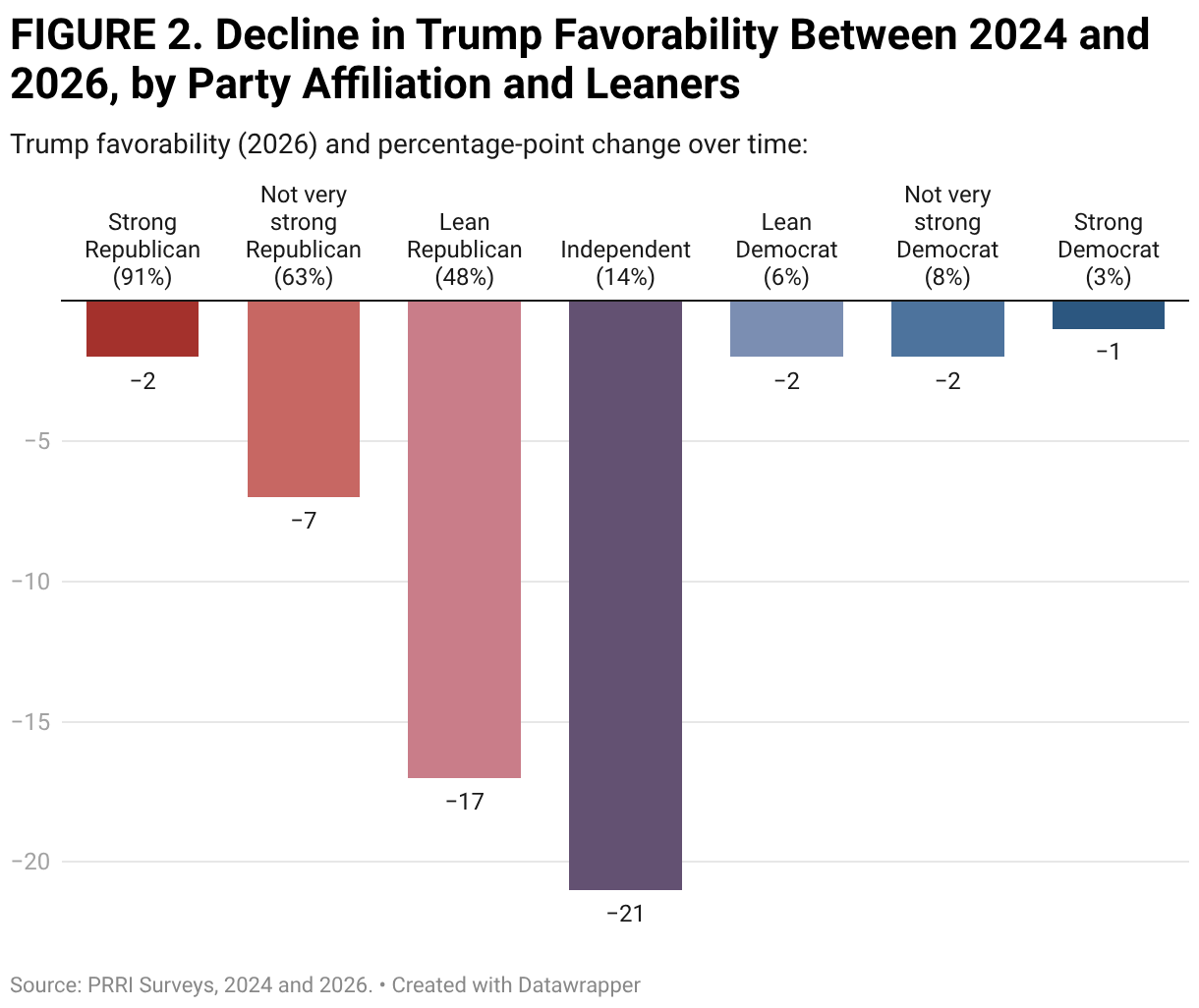
Chart 2. Trump Favorability by Religious Affiliation
Among religious groups, Hispanic Christian groups have experienced the steepest decline in Trump favorability over the last two years (14 points), with Hispanic Protestants down to 37% and Hispanic Catholics down to 23%. Non-Christian religious Americans follow, with a 9 percentage-point decline from 27% in 2024 to 18% today. Favorability of Trump among all white Christians declined by 5 percentage points, while religiously unaffiliated support of the president dropped by 4 points and now stands at 21%.
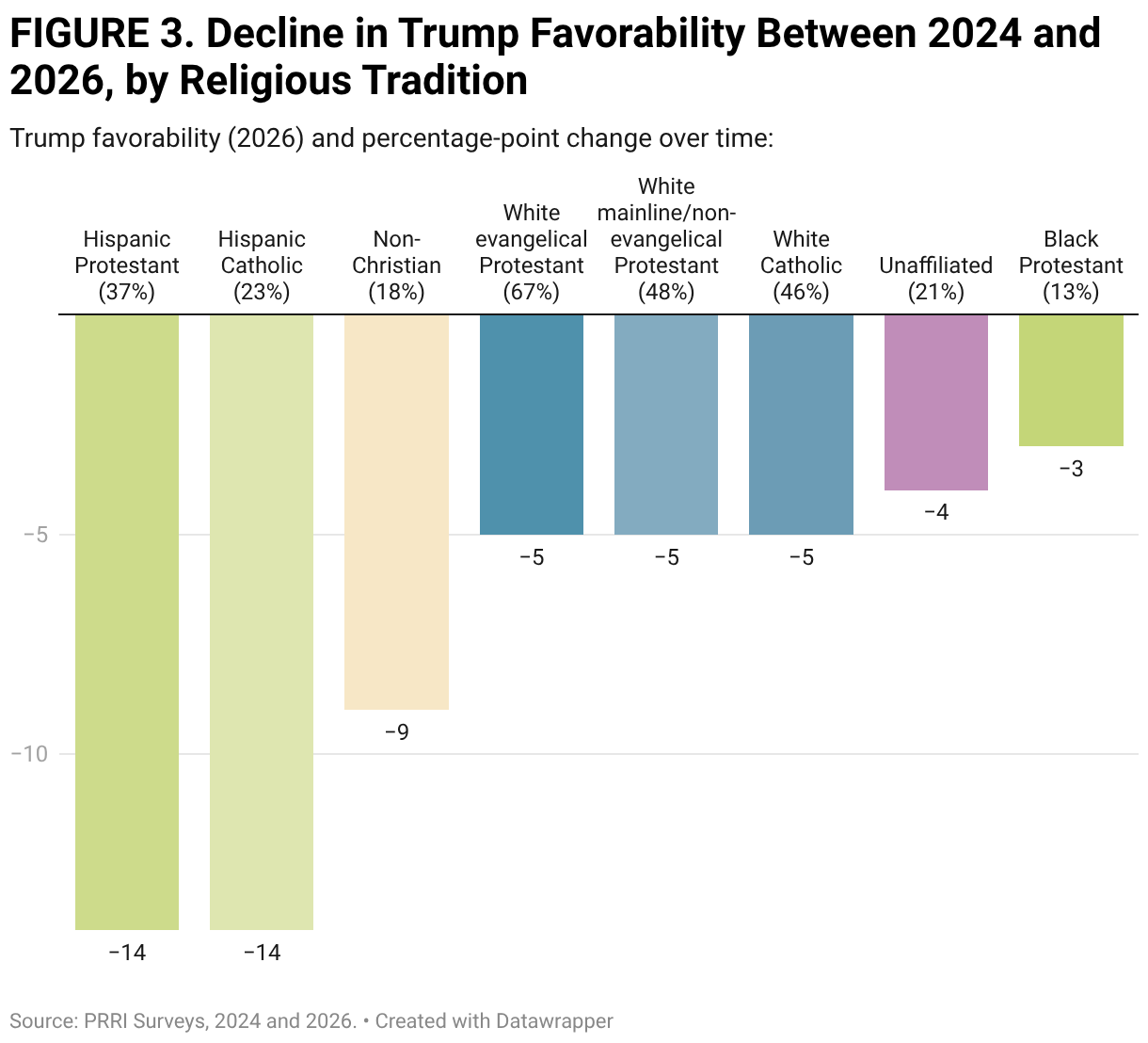
White evangelical Protestants are now the only religious group in which a majority (67%) view Trump favorably, and Trump’s popularity has dropped 5 points even among this group since the 2024 election, and 9 points from an all-time high of 76% in May 2025.
Similarly, a slight majority of white Catholics (51%) viewed Trump favorably in September 2024. Today, that number has dropped to 46%, with the majority of white Catholics (54%) holding unfavorable views. In addition, Trump’s favorability dropped 8 points among white mainline/non-evangelical Protestants from 53% in September 2024.
Since 2015, Donald Trump’s favorability among Black Protestants has remained relatively stable, never reaching higher than 19%. Trump favorability among Black Protestants stands at 13% in May 2026.
The bottom line: As this administration continues to run roughshod over democratic norms and entangle our nation in unjust wars of choice, only one-third of Americans hold a favorable view of President Trump. And with the lone exception of white evangelical Protestants, he has now lost the support of all other religious groups in the country, including those groups who gave a majority of their votes to him in 2024.
Related at Redeeming Democracy

PRRI Day of Giving - Support Independent Data
Public opinion is the lifeblood of democracy. As the pioneering political scientist Harold Lasswell observed, “the open interplay of opinion and policy is the distinguishing mark of popular rule.” In a representative system, public opinion connects leaders to the people they serve — ideally acting as a check against the abuse of power.
But rigorous, independent research doesn’t sustain itself. At a moment when serious public-interest journalism and evidence-based research are increasingly under threat, your support is what keeps this work going.
Please consider making a tax-deductible donation to PRRI today:


