

Train Up a Child: The Atrocity of a Mock Execution in a Church
A guest post by Rita Nakashima Brock and Susan Brooks Thistlethwaite


From time to time, we include guest posts at Redeeming Democracy. I’m grateful to theologians Rita Nakashima Brock and Susan Brooks Thistlethwaite for today’s insightful post.
The politics of hate does not fall from the sky. In the U.S., it is deliberately created and sustained by rituals and themes from Christian theology that date back to the time of the Crusades, when the idea of “holy” war replaced just war, and enemies, especially Jews and Muslims, were demonized as agents of Satan.
Recently, a Vacation Bible School skit at a Lexington, Kentucky, church drew national attention after a video showed men dressed as soldiers entering a sanctuary carrying airsoft-style rifles and “executing” a person who portrays the devil. The murder occurs on the chancel steps as a pastor presides over it. He leads the children to cheer repeatedly, “Take him out! Blow him up!” The “devil,” clothed in a black hoodie, writhes on the ground in agony, seems to die, and is carried out a side door by the shooters. Very young children, who often cannot distinguish a simulation from reality, are present in the crowd.
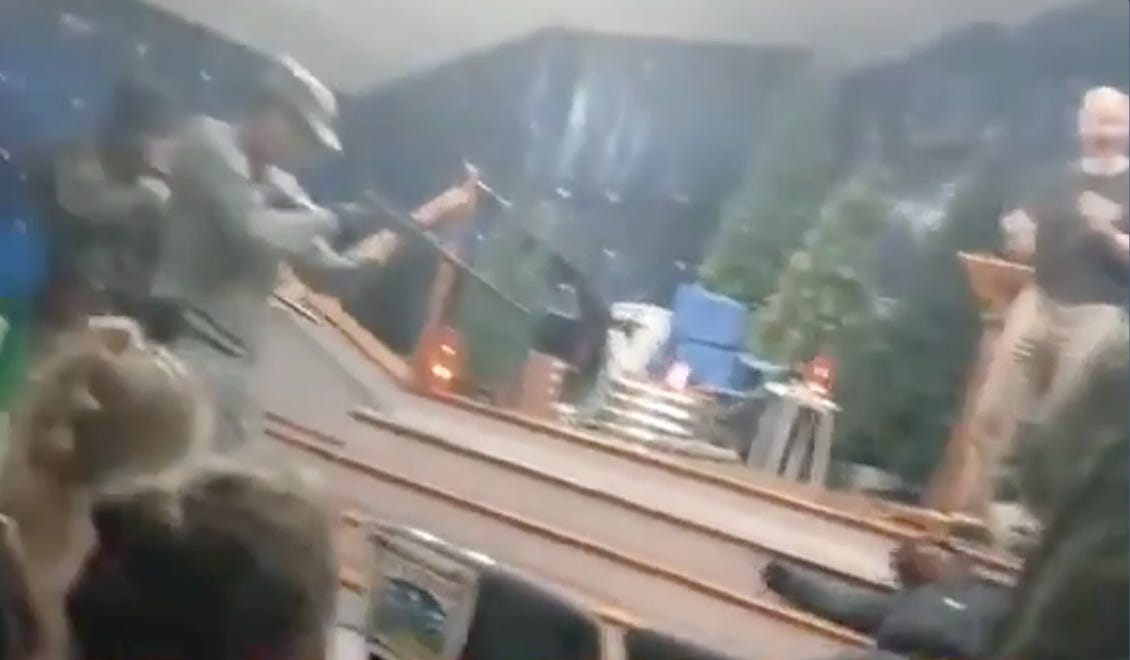
Children are not born haters; they have to be trained to believe that God sanctions violence against what they are taught to hate. Such graphic enactments groom children to accept lethal violence. While this particular event might seem shocking, it has deep roots in Christian atonement theology, the idea that someone must violently suffer for sin. God required Jesus to be tortured and murdered on the cross to redeem sinful humanity and save us from eternal torment in hell.
Atonement theology, however, was not the dominant form of soteriology in early Christianity. But it was heavily promoted in 1096 as war propaganda for the crusades, with Pope Urban II recruiting fighters by declaring “Deus Vult!” (God wills it!). Christians were supposed to be willing to die for Christ as he died for them—with an additional bonus: the remission of any debts, both financial and spiritual. (Notably, that violent Latin Crusader phrase is tattooed on Pete Hegseth’s upper arm.)
Atonement theology and ritually enacted violence groom children to hate, first the Devil and then, inevitably, the humans they are convinced are his agents.
Once atonement theology established itself as orthodox doctrine, it created an expansive space within Christianity for violence. Medieval executions in parts of Europe were public events, attended by everyone in town, including children. Crowds reenacted the crucifixion by weeping as the victim ritually forgave them for the killing and then cheered the execution—capital punishment as ritual enactment and gruesome entertainment.
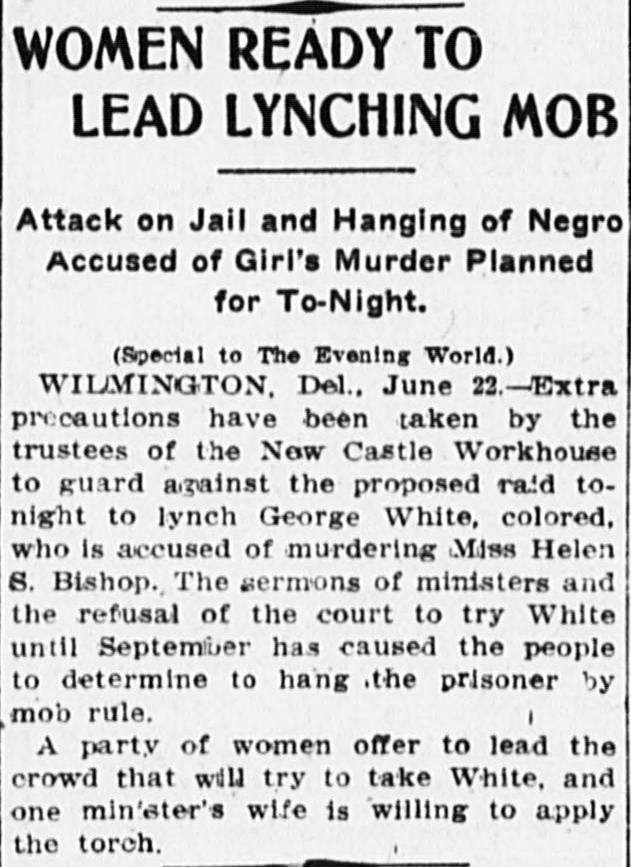
After the Civil War and into the 20th century, public lynchings helped grow and sanctify the virulence of white racism, and not just in the South. Some local newspapers gave the time and place of lynchings so schools could close and families, dressed for a picnic, could attend. Bodies were often set on fire. In this news article from Delaware, it is clear northern white women could take a leading role in sanctifying lynching as a Christian act. “One minister’s wife is willing to apply the torch.”
Attendees, including children, collected charred bones and fabric as souvenirs. Photographers set up tents to take pictures and produce postcards for people to send to friends and family. Rita attended an exhibition of those horrifying postcards at the Ruth Horowitz Gallery in New York—some show smiling white children in them. They are collected in a book called “Without Sanctuary: Lynching Photography in America” (Twin Palms Publishers, 2000).
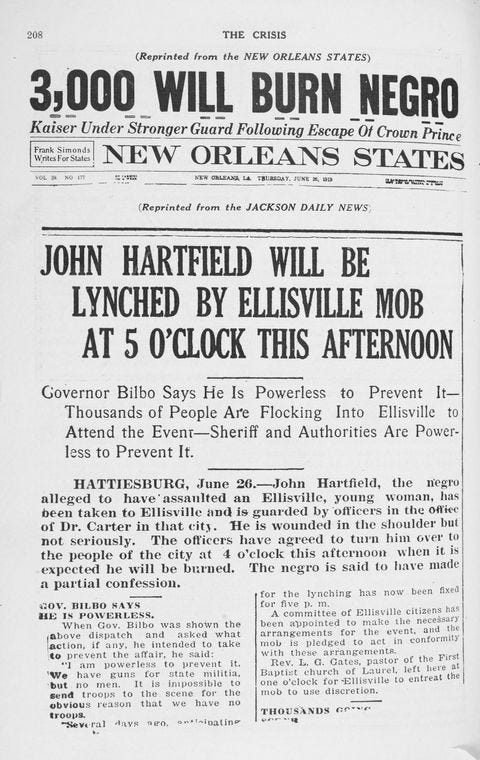
These public lynchings were illegal and at the same time tacitly approved, as in this news article where Mississippi Governor Thomas Bilbo, a former Baptist preacher and purveyor of white supremacist Christianity, claims to be “powerless” to stop it.
More recently, Mel Gibson’s “The Passion of the Christ” illustrated this strain of Christianity with an intense, hyper-violent depiction of Jesus’ final hours. The flogging of Jesus as sadistic theological porn goes on for fully forty minutes. Flecks of skin spatter the crowd while Satan looks on approvingly. When Susan went to see the film, the theater was filled by parents with young children, some of whom cried and screamed at what was being shown on the screen.
Against this backdrop, it is clear that the current attempt to merge violence and far right politics with Christianity is not an aberration. Atonement theology, which sanctifies execution as an act of grace and love, sits at the center of White Nationalist Christianity.
Right-wing, atonement-based Christianity adores religiously motivated violence, ritually repeated as habits of behavior and belief. The Vacation Bible School event, as horrible as it is, was just one iteration of an obsession with hate-filled violence. The church pastor, who led the enactment, defended it by saying Christians were forbidden to hate anyone, except the devil, so the lesson was to generate hate and direct violence toward the devil.
But these strong theological currents that run through white supremacist culture are not so easily tamed. They make violence not only permissible but inevitable, as a means of purging society of what is labeled “evil.” Atonement theology and ritually enacted violence groom children to hate, first the Devil and then, inevitably, the humans they are convinced are his agents.
Rita Nakashima Brock, Ph.D., is a theologian and co-author of Proverbs of Ashes: Violence, Redemptive Suffering and the Search for What Saves Us and Saving Paradise: How Christianity Traded Love of This World for Crucifixion and Empire. She offers courses on moral injury twice a year via the Soul Repair Center at Brite Divinity school.
The Reverend Susan Brooks Thistlethwaite, Ph.D., is President Emerita and Professor Emerita of Chicago Theological Seminary. She is the author or editor of 17 academic books and 7 novels, and she has been a translator for two different translations of the Bible. She writes on Substack at “No Fear Religion and Politics.”
Recently on Redeeming Democracy

 | A guest post by
|