

Let's Tell a New Story: Juneteenth and a Season of Critical Patriotism [New Book Excerpt]
The 15 days that span the space between Juneteenth and Independence Day could function as an enduring season of critical patriotism for our time.

Note: This post is an excerpt from a chapter entitled “Juneteenth” in my forthcoming book, Backslide: Reclaiming a Faith and a Nation After the Christian Turn Against Democracy, which will be published September 8 and is now available for pre-order.
In honor of the period between Juneteenth and Independence Day, I’m offering a discount for all paid annual subscribers.
The Hebrew children have their Passover so that they can keep their history alive in their memories—so let us take one more page from their book and, on this great day of deliverance, on this day of emancipation, let’s us tell ourselves our story….
― Rev. Alonzo Hickman, in Ralph Ellison’s Juneteenth [i]
In 1852, the Ladies’ Anti-Slavery Society of Rochester, New York, invited Frederick Douglass to give a speech at Corinthian Hall, the city’s most prestigious public venue, on the 76th anniversary of the Declaration of Independence. That speech—delivered deliberately on July 5th to emphasize the theme of his message—became known by Douglass’s central piercing question, “What, to the American slave, is your 4th of July?”[ii]
After a prayer and a reading of the Declaration of Independence by two white ministers, Douglass stepped onto the familiar high speaker’s platform without an introduction, cradling his 30-page text. Douglass drew on the tradition of the Hebrew prophets, prepared to deliver an American jeremiad. But he did not merely unleash anger at the hypocrisy of white celebrations of independence in a nation where chattel slavery remained legal. Douglass crafted a piece of art, what historian David Blight describes as a rhetorical “symphony in three movements.”
In the first movement, Douglass established common ground with his white audience. He praised the genius of the founding fathers and referred to the Fourth of July as an American Passover, a holiday that holds a narrative we performatively tell ourselves about our origins, journey, and identity. But he also warned that all was not well. The nation’s two largest white religious bodies, the Baptists and the Methodists, had each split into northern and southern factions over the issue of slavery in 1845; southern politicians had succeeded in passing the brutal Fugitive Slave Act in 1850; and Harriett Beacher Stowe’s Uncle Tom’s Cabin, published just three months prior to his speech in 1852, had fanned the flames of the abolitionist movement, deepening divisions among the country’s white population.
When Douglass spoke of “dark clouds…above the horizon…portending disastrous times,” he was describing a gathering of forces his audience palpably sensed. Yet, Douglass said, the nation’s destiny was still malleable. There was still time to avoid calamity, but only if its citizens would cling fiercely to its founding principles of freedom and equality.
Douglass then shifted to the middle portion of the speech, a crescendo he sustained for fourteen pages. He shifted his possessive pronouns from “our” to “your,” forcefully highlighting the distance between himself and his white audience. In wave after wave of powerful prose, filled with memorable metaphors, he exposed the hypocrisy of slavery in a republic founded on the Declaration of Independence. “Fellow citizens,” he finally asked, “pardon me, allow me to ask, why am I called upon to speak here today? What have I, or those I represent, to do with your national independence?”
As he elaborated on this question, he pulled no punches:
I am not included within the pale of this glorious anniversary! Your high independence only reveals the immeasurable distance between us. The blessings in which you, this day, rejoice, are not enjoyed in common. The rich inheritance of justice, liberty, prosperity and independence, bequeathed by your fathers, is shared by you, not by me. The sunlight that brought light and healing to you, has brought stripes and death to me.
This Fourth July is yours, not mine. You may rejoice, I must mourn. To drag a man in fetters into the grand illuminated temple of liberty, and call upon him to join you in joyous anthems, were inhuman mockery and sacrilegious irony. Do you mean, citizens, to mock me, by asking me to speak to-day?[iii]
He closed the second movement of the speech with an unflinching indictment of complacent white churches, declaring that slavery “brands your republicanism as a sham, your humanity as a base pretense, and your Christianity a lie.” In a harrowing final image, Douglass warned that slavery was “a horrible reptile,” a “venomous creature…nursing at the tender breast of your youthful republic.” [iv] The nation and its ideals, Douglass insisted, would only survive if its white citizens ripped slavery from its intimate place in their lives and cast it aside.
Douglass paused to allow the echoes of his baritone voice to fade in the still hall.
In the final movement of the speech, he again held out hope that the United States might yet live to be a nation worthy of its professed values. “Notwithstanding the dark picture I have this day presented of the state of the nation,” he declared, “I do not despair of this country.” Even while exposing their blind spots and contradictions, Douglass thought it appropriate to honor the memory of the “statesmen, patriots and heroes…for the good they did, and the principles they contended for.” In this masterful performance, Douglass was asking his white audience to hold their naive patriotism up next to his dissonant reality, not to cast shade but to light the road yet to be traveled.
As he wrapped up the speech, the 600 mostly white listeners spontaneously rose to their feet and let out a cheer accompanied by “a universal burst of applause.”[v] Through this ovation, the audience acknowledged the truth of Douglass’s experience. The Fourth of July was an incomplete version of the American story; it was their story, perhaps, but it was not his story and, therefore, could not be the nation’s story.
Growing up, the Fourth of July was the nation’s great official summer holiday. It provided a break between the three months separating the other two federal holidays that bookend the summer: May’s Memorial Day and September’s Labor Day. But on June 17, 2021, the status of Independence Day as the nation’s lone summer holiday changed. President Joe Biden signed legislation adding a second official summer holiday, Juneteenth, to the calendar—the first new federal holiday since Martin Luther King Jr. Day was designated in 1983.
In short, Juneteenth marks the day that enslaved African Americans in Texas finally received the news that they were free. Juneteenth celebrates the date—June 19, 1865—when the Union Army’s Major General Gordon Granger issued General Orders No. 3, an order that notably went beyond even the language of Lincoln’s declaration, specifying that the new arrangement stipulated “an absolute equality of personal rights and rights of property between former masters and slaves.”[vi]
The holiday is the oldest continuous celebration of African Americans’ emancipation from slavery in the country. It is the day African Americans themselves have most celebrated, first in Texas, and then, spreading with the Great Migration, in the rest of the nation. As Texas-born Pulitzer-Prize winning historian Annette Gordon-Reed notes, the holiday is also a fitting addition to the national pantheon because it originates in a state where all the strands of the American story—“a story of Indians, settler colonists, Hispanic culture in North America, slavery, race, and immigration”—are manifest.[vii] At the 2021 bill signing ceremony, President Biden declared, “By making Juneteenth a federal holiday, all Americans can feel the power of this day, and learn from our history, and celebrate progress, and grapple with the distance we’ve come but the distance we have to travel.”[viii] Biden issued a similar proclamation marking the new federal holiday in each of the four years of his presidency.
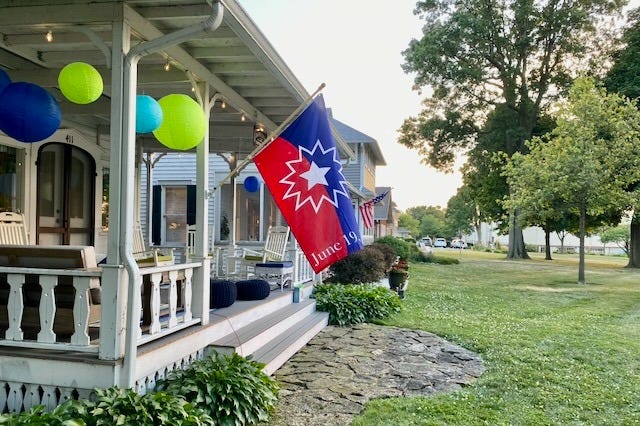
But the re-election of Donald Trump to the presidency in 2024 marked an aggressive reversal. Consistent with his broad attempts to erase Black history from the American story, President Trump refused to issue the customary presidential proclamation recognizing Juneteenth during the first year of his second term and removed it from the list of free admission days at the more than 100 national parks across the country. Instead, on the evening of June 19, 2025, Trump posted a not-so-subtle message on Truth Social complaining that there were “too many non-working holidays” in the country and that they are “costing our Country $BILLIONS OF DOLLARS to keep all of these businesses closed.”[ix] Notably, this message echoed racist Senator Jesse Helms’s disingenuous objection to the establishment of Martin Luther King Jr. Day in 1983. During a failed filibuster attempt to derail the bill, Helms protested that the cost of a new national holiday would be $12 billion in lost productivity.[x]
Clearly, the holiday, and the nation, are at a crossroads. We’ve had just five short years—with the first mired in the Coronavirus pandemic—to practice celebrating Juneteenth as a nation. White Americans, especially, were just beginning to connect with the holiday. And now, a white supremacist president is telling us it need not be acknowledged.
With a sitting president openly denigrating our newest national holiday, a transposed version of Douglass’ question is relevant for us today: What, to the white American, is the 19th of June?
In a conversation about my own uncertainty about how to appropriately celebrate Juneteenth as a white American, my friend Rev. Jacqui Lewis, the innovative African American senior minister of Middle Collegiate Church in New York City, suggested that because of its proximity to Independence Day, both temporally and conceptually, our newest federal holiday has great potential to help rehabilitate the Fourth of July from the jingoistic Christian nationalism it all too often evokes. As I reflected on that insight, I realized that one way to more securely incorporate Juneteenth into mainstream American culture would be to cultivate what we might call a “season of critical patriotism” between the two holidays.
Among the many gifts of being in an interfaith marriage is the ongoing invitation to experience and learn from a tradition that is not your own. As I’ve celebrated the Jewish High Holidays as a Christian over the last 20 years, I’ve been moved by the power of the moral space that opens in the ten days between a celebration of the promise of the new year on Rosh Hashanah (the head of the year) and lament over the failings of the past year at Yom Kippur (the day of atonement). The sweetness of apples and honey foreshadows the bitterness of fasting and repentance. On the calendar, these holidays occur in a line. But conceptually, they orbit one another like binary stars, generating a contemplative space between them known in Judaism as the “days of awe.”
The period of 15 days that span the space between Juneteenth and Independence Day could similarly function as an enduring season of critical patriotism for our time. Alongside the celebratory fireworks and other well-established practices surrounding the Fourth of July, we could develop a new civic liturgy that include the creative interplay of lament and celebration, reckoning and repair, truth-telling and hope. Borrowing from the High Holidays model, Juneteenth could function like Yom Kippur, recalling our struggles to overcome our shortcomings and achieve freedom, while Independence Day could echo Rosh Hashanah, recommitting us to shared national ideals.
Such a practice could also embrace a conviction that is deeply engrained in Judaism, Christianity, and indeed most religious traditions—that no people can live with integrity into the future if they cannot face their past failures to live up to their principles. Douglass saw this truth clearly, noting that any nation who was false to the past also “solemnly binds herself to be false to the future.” And President Biden observed this truth when he signed the legislation making Juneteenth a federal holiday, “Great nations don’t ignore their most painful moments. They don’t ignore those moments of the past. They embrace them…. And in remembering those moments, we begin to heal and grow stronger.”[xi]
Bringing the Juneteenth and the Fourth of July together in a creative mutual orbit, where each is embraced by the gravitational force of the other, can also help us develop other rituals that are honest about our country’s failings while also being hopeful about its possibilities.
Even amid our divisions, most Americans still want to embrace the vision of a pluralistic society. We need new rituals now more than ever. The attacks on the celebration of Juneteenth are testimony to their vital importance today. If we’ll let them, the proximity of Juneteenth to Independence Day can provide a civic space that helps us cope with the dilemma created by the gap between our highest principles and our historical contradictions. The creative energy generated by these pairings holds considerable promise for generating a new spirit of critical patriotism we sorely need.
Fairy-tale narratives of impossible national innocence are thankfully no longer credible, particularly to nonwhite or non-Christian Americans, or, as polling data consistently shows, to most Americans under the age of 40. But we ought not allow the harsh light of historical indictment to eclipse the noble principles still waiting to be realized.
So, as Ralph Ellison’s Black preacher says in this chapter’s epigraph, “let’s us tell ourselves our story,” one of America as a flawed but precious work in progress. White Christian nationalist protestations to the contrary, such a critical patriotism is not divisive; it is what may finally allow us to be whole.
25% Discount Offer for the 250th Anniversary
In honor of Juneteenth and Independence Day, and in recognition of our nation’s 250th anniversary, I’m making available a 25% discount off of all annual paid subscriptions activated by July 4th.
If you are able, please consider becoming a paid subscriber to my newsletter as we work to strengthen our democracy together.
Your paid subscription helps sustain my work, keeps most content free for everyone, and gives you full access to engaging community conversations and author salon webinars. It also represents your commitment to supporting unflinching writing and analysis on religion, racial justice, and democracy. That’s never been more critical.
*Note: If you’d like to receive the benefits of being a paid subscriber but cannot afford it, drop me a note at robertpjones.substack@pm.me and I can arrange a complimentary paid subscription.
[i] Ralph Ellison et al., Juneteenth, First Vintage International edition (Vintage International, 2021), 117.
[ii] For a moving account of Douglass’ speech, see David W. Blight, Frederick Douglass: Prophet of Freedom (Simon & Schuster, 2018), 229–36.
[iii] Frederick Douglass, “What to the Slave Is the Fourth of July?,” Speech, Rochester, NY, July 5, 1852, https://archive.org/details/Douglass_July_Oration/page/2/mode/2up.
[iv] Blight, Frederick Douglass, 234–35.
[v] Blight, Frederick Douglass, 236.
[vi] Gordon Granger, “General Orders, No. 3,” Galveston Tri-Weekly News (Galveston, TX), June 20, 1865, https://web.archive.org/web/20200622014256/https://www.cah.utexas.edu/db/dmr/image_lg.php?variable=di_01803.
[vii] Gordon-Reed, On Juneteenth, 14.
[viii] Joseph Biden, “Remarks by President Biden at Signing of the Juneteenth National Independence Day Act,” Speech, Washington, DC, June 17, 2021, https://bidenwhitehouse.archives.gov/briefing-room/speeches-remarks/2021/06/17/remarks-by-president-biden-at-signing-of-the-juneteenth-national-independence-day-act/.
[ix] Aishvarya Kavi, “Juneteenth Goes Uncelebrated at White House as Trump Complains About ‘Too Many’ Holidays,” The New York Times (New York, NY), June 19, 2025, https://www.nytimes.com/2025/06/19/us/politics/juneteenth-white-house-slavery.html.
[x] Lily Rothman, “How MLK Day Became a Holiday,” TIME, January 20, 2020, https://time.com/3661538/mlk-day-reagan-history/.
[xi] Biden, “Remarks by President Biden at Signing of the Juneteenth National Independence Day Act.”
Magnificent. thank you.
Truly, inspired words. And, I love your suggested reflection time between Juneteenth and July 4th.