

Senators Clear the Way for Hegseth's Christian Nationalist Crusade
Not a single senator probed the most dangerous part of Hegseth's background: his support for white Christian nationalism.

It’s hard to find strong enough adjectives to describe the unmitigated disaster the senate hearing on the nomination of Pete Hegseth for Secretary of Defense was. Even the few Republicans who had expressed previous concerns about his nomination handled him with kid gloves. There were some strong challenges by Democratic senators focused on the important issues of Hegseth’s disparagement of women in the armed forces, his alleged drinking on the job, allegations of sexual assault and misconduct, his poor performance in his only management positions running two small nonprofit veterans organizations, and lack of any relevant experience for the massive responsibilities of the job for which he is being considered.
But not a single senator from either side of the aisle probed the most dangerous part of Hegseth’s background: his support for Christian nationalism, a set of beliefs that undermine the bedrock principles of a racially and religiously pluralistic democracy.

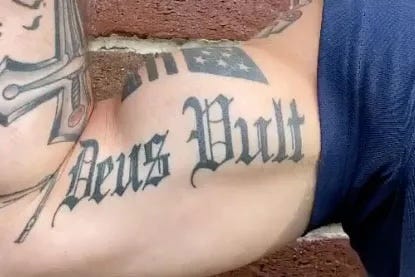
Here are just a few examples of Hegseth’s documented extremist Christian nationalist views that went unchallenged:
Deus Vult. As multiple photos circulated online have demonstrated, Hegseth has two tattoos that together represent a Christian nationalist worldview that glorifies the medieval Christian Crusades against Muslims and that are popular among white supremacist and Christian nationalist groups. The tattoos consist of a constellation of five Jerusalem crosses on his right chest, which sit adjacent to a images of a sword crowned by the Latin phrase “Deus Vult” (“God wills it”) on the inside of his right arm. As the Washington Post and others have documented, that Latin slogan has been used by extremists “including the man who opened fire on two New Zealand mosques in 2019 — killing 49 Muslims — and white nationalists, such as some of those who marched in Charlottesville in 2017. And it appeared on clothing and on at least one flag carried by rioters on Jan. 6.” Hegseth himself has identified Deus Vult as a “battle cry” of the crusades. Following the insurrection, National Guard security official warned in an email to the D.C. National Guard commander that Hegseth, who was at the time serving in a unit called up to provide security for Biden’s inauguration, could be an “insider threat.” Concerned, the commander told Hegseth he did not need to report for the assignment. Soon after that event, Hegseth left the military, summarizing his exit this way, “So, I resigned. On Jan. 20, 2021, I drafted the letter. F*** Biden anyway.”
Thank a Crusader. But Hegseth’s Christian nationalist extremism isn’t confined to symbols. Hegseth has written that people who enjoy the benefits of “Western civilization” should “thank a Crusader.” In his 2021 book, which is actually titled, American Crusade, Hegseth explicitly advocates the use of violence when democratic means don’t achieve his fellow Christian nationalists’ desired results. “Voting is a weapon, but it’s not enough,” Hegseth declared. “We don’t want to fight, but, like our fellow Christians one thousand years ago, we must.”
Kill all Muslims! In December 2024, Jane Mayer reported in The New Yorker that a coworker at Concerned Veterans for America, one of two small nonprofits Hegseth has run, lodged a complaint against Hegseth after he and an associate began chanting “Kill All Muslims! Kill All Muslims!” in “a drunk and a violent manner” at a bar while on official travel for a work event.
Close ties to Christian nationalist institutions. Hegseth is a member of Pilgrim Hill Reformed Fellowship, a small newly-founded church that is part of the Communion of Reformed Evangelical Churches (CREC). The denomination was co-founded by Doug Wilson, a self-described Christian nationalist who embraces a theocratic vision of Christian dominance of all institutions in society. Wilson has written that slavery produced “a genuine affection between the races” and argues that homosexuality should be a crime. Wilson holds particularly rigid patriarchal views, asserting that giving women the right to vote was a mistake, that women holding political office “should be reckoned not as a blessing but as a curse,” and that women should not “be mustered for combat” (sound familiar?). As religion scholar Julie Ingersoll, who has studied this movement for years, points out, adherence to these theological tenets are not optional in CREC churches. Hegseth is a member in good standing and has called Wilson a spiritual mentor, explicitly saying that he is a disciple of Wilson’s teachings and learning from his books.
All of these concerns were matters of public record and available to senators before the hearing. Moreover, they were explicitly brought into the room not only by protesters but by Republican senators themselves. Yet, no Democratic senators thought them worthy of serious attention and scrutiny.
The first part of the hearing was interrupted by two protests, each of which brought attention to Hegseth’s professed Christian nationalism. The Capitol Police had to escort out of the room an elderly protester who said he was a Vietnam War veteran who yelled “you are a Christian Zionist” at Hegseth. And two Codepink protesters held up signs that read, “NO HEGSETH, NO RELIGIOUS EXTREMIST, NO CHRISTIAN JIHAD.”
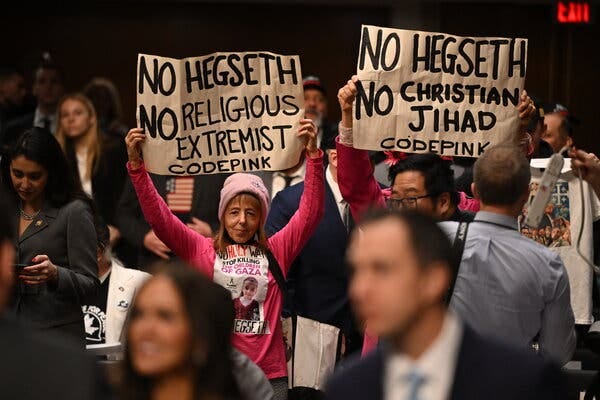
The only two senators who addressed these issues were Sen. Tom Cotton (R-Arkansas) and Sen. Kevin Cramer (R-North Dakota), who served layup questions to Hegseth allowing him to misrepresent their true nature.
“I’m not really sure why that is a bad thing — I’m a Christian, I’m a Zionist,” Sen. Cotton began, referencing the protesters’ objections. “Do you consider yourself a Christian Zionist?” While Hegseth declined to embrace the label directly, he replied, “I’m a Christian and I will robustly support the state of Israel and its existential war in Gaza.” When Cotton asked further about Israel’s war in Gaza, Hegseth further affirmed that he supported “Israel destroying and killing every last member of Hamas.”
Sen. Cramer framed his question with a smirk and open sarcasm: “You had mentioned that you were not able to serve with your national guard unit in the protection of the inauguration of Joe Biden because of a tattoo, a Christian tattoo. Can you elaborate just a little bit on what is this very offensive, extremist, racist tattoo that you have?”
Hegseth had clearly prepared a scripted answer to this question:
It’s called the Jerusalem cross. It’s a historic Christian symbol. In fact, interestingly recently I attended briefly the memorial ceremony of former President Jimmy Carter, on the floor of our national cathedral, on the front page of his program was the very same Jerusalem Cross. It is a Christian religious symbol.
Hegseth went on to note that his orders to serve as a National Guardsman during President Joe Biden’s inauguration were revoked and that he was not told why at the time but later understood that it was because he was “identified as an extremist by my own unit for a Christian tattoo.”
And that was the beginning and the end of any questions about Hegseth’s Christian nationalist views at his confirmation hearing to become Secretary of Defense. Abdicating their duty to rigorously advise before consenting, they allowed these evasions and distortions to stand unchallenged in the record.
A simple thought experiment reveals the deep level of Christian bias operating in these decisions. Let’s assume, for example, that the nominee was a Muslim Democratic Party nominee, rather than a Christian Republican nominee, who did the following:
Included this language in his opening statement (a near verbatim Muslim version of Hegseth’s opening statement): “Thank you to my incredible wife Aaliyah, who has changed my life and been with me throughout this entire process. I love you, sweetheart, and I thank Allah for you. And as Aaliyah and I pray five times each day, all glory — regardless of the outcome — belongs to Allah and his prophet Muhammad, blessed be his name. May Allah’s grace and mercy abound each day. Inshallah.”
Responded to questions about Israel’s war in Gaza with this statement: “I’m a Muslim and I will robustly support the Palestinians in their existential war against the state of Israel.”
Had a tattoo of a crescent on his chest, coupled with a scimitar and the words “Allah wills it” in Arabic on his bicep—symbols that resulted in him being prohibited from serving at Trump’s previous inauguration after one of his fellow soldiers reported him to his superiors as a potential insider threat.
Talked positively about medieval jihad and Muslim conquest of Jerusalem and had a coworker file a complaint against him for yelling “Kill all the Christians!” during a drunken episode at a bar.
Was a member of a mosque and Islamic theological movement that promoted the dominance of all areas of society by Muslims and held the subjection of women in both the private and public spheres as a central tenet.
In philosophy, we employ such thought experiments to expose double standards that may be hidden by our inherent biases. One can only imagine the outrage that would come from Sen. Cotton and Sen. Cramer, and virtually all of the other Republican senators, in the scenario above. If these traits seem dangerous when translated to a minority religion but not when applied to the majority religion, they expose a bigoted Christian bias, one that is giving harbor to Hegseth’s religious extremism. But the more familiar trappings of Christian identity should not hide the dangerous implications of this particular incarnation of the Christian faith. Nor should it exempt it from scrutiny.
If it was not outright cowardice, the Democratic senators’ timid refusal to interrogate Hegseth’s Christian nationalist worldview was at best rooted in a desire to respect the Constitution’s important prohibition against instituting a religious test for office. But if this was the reason for their failures during the hearing, it reflects a serious misunderstanding of the purpose of that principle.
The Founders were primarily concerned about prohibiting the then familiar practice of reserving offices for members of religious groups favored by the state. But that Constitutional protection in no way prohibits lines of questioning related to whether a nominees’ publicly professed beliefs and worldview, whether religious or secular, are compatible with the fundamental principles of a pluralistic democracy and the oath of office they will take to defend and obey not a president but the Constitution.
The Republican Party—whose adherents are two thirds white and Christian in a nation that is only 41% white and Christian—has clearly given itself over to the white Christian nationalist vision that fuels Trump’s MAGA movement. If, over the next four years, if the Democratic Party continues to ignore the clear and present danger white Christian nationalism represents, history will judge them harshly for their naiveté and their abdication of duty to our nation in its time of need.
In American Crusade, Hegseth wrote, “Our American Crusade is not about literal swords, and our fight is not with guns. Yet.” With his nomination looking likely to succeed, that yet has arrived. And now, Trump will have his willing leader of a Christian nationalist crusade that will be fought—not just abroad but at home—with the most lethal forces and arsenal of weapons the world has ever seen.
Related on #WhiteTooLong
A Peaceful January 6th Offers Little Reassurance about Our Democracy

On September 11, 2024, two months prior to the 2024 election, the Secretary of Homeland Security designated January 6, 2025, as a “National Special Security Event.” The press release announcing this decision explained that this designation had been made based on recommendations from the House Select January 6 Committee, the Government Accountability Off…
In Speech to White Evangelical Broadcasters, Trump Lays Out His White Christian Nationalist Vision

I know, it’s easy to dismiss Trump’s extremist rhetoric as just another occasion of “Trump being Trump.” Because the deluge is unrelenting, paying attention is emotionally and morally exhausting. But especially now that he has essentially secured the nomination as the next GOP presidential candidate, it is vital that we sound the alarm as Trump tells us…
Taking the White Christian Nationalist Symbols at the January 6 Insurrection Seriously

Dear #WhiteTooLong readers,
Thanks for writing this. Terrible dereliction of duty by US Senators.
Thanks for this. It is right to insist that the religious commitments of public officials deserve scrutiny, especially when they appear to sanctify violence or frame geopolitical conflict in civilizational terms. But the deeper problem may not lie solely in the rise of “Christian nationalism” as a contemporary ideology. The temptation he identifies is far older. Long before our current political vocabulary, empire learned how to clothe itself in sacred language—casting wars as providential, enemies as civilizational threats, and power itself as participation in a divine order. For nearly a millennium after Constantine, political authority in the West was articulated through theological categories; sovereignty, law, and hierarchy were imagined as reflections of sacred reality. The Reformation disrupted many things, but it largely rearranged the furniture within the same house—painting some walls, moving others, yet leaving the deeper architecture of sacralized authority largely intact. Even after the Enlightenment translated those concepts into secular language, much of that structure remained. What we are witnessing today may therefore be less the sudden rise of Christian nationalism than the resurfacing of a long inheritance: the enduring habit of fusing religious imagination with imperial power and vice versa.