

New Data: Most Republicans Now Hold a Favorable View of Christian Nationalism
Christian nationalists are now openly embracing the term.

Over the last decade, the empirical evidence for the existence of the worldview sociologists now call “Christian nationalism” has mounted. Using various methodologies from different datasets over time, dozens of rigorous scientific studies have shown a fairly consistent picture: that about one-third of Americans—including a majority of Republicans and two-thirds of white Evangelical protestants—share the view that America was intended by God to be a kind of promised land for European Christians.
Here are four key sources:
Sam Perry and Andrew Whitehead, Taking American Back for God: Christian Nationalism in the United States;
Phillip Gorski and Sam Perry, The Flag and the Cross: White Christian Nationalism and the Threat to American Democracy; and
Four full years of studies by PRRI , including our recent large-scale study based on over 22,000 interviews, Mapping Christian Nationalism Across the 50 States: Insights from PRRI’s 2025 American Values Atlas.
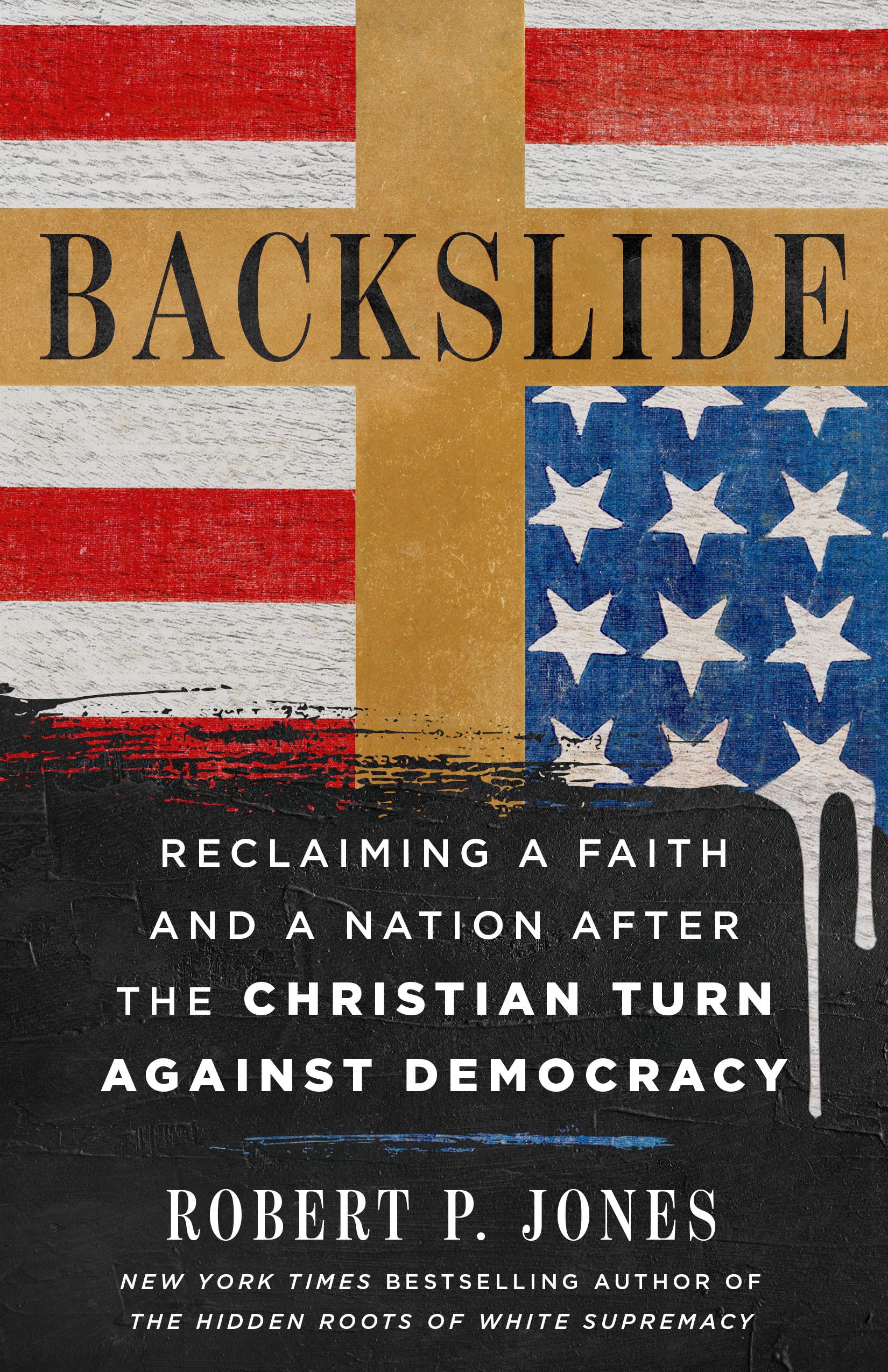
My new book, Backslide: Reclaiming a Faith and a Nation After the Christian Turn Against Democracy (available for pre-order now).
Each time we’ve released a new PRRI study, despite the transparent methodology and consistent findings over time, conservative white evangelical apologists predictably object that the term “Christian nationalism” is a term invented by religiously hostile academics to malign Christians. PRRI’s most recent findings should put an end to those protestations.
Two thirds of those who qualify as Christian Nationalism Adherents hold a favorable view of the term “Christian nationalism.”
It turns out that most of those who qualify as “Christian nationalists” by independent criteria actually now embrace the term. Here are the details, hot off the press in a large 5,000-person study PRRI released last week.
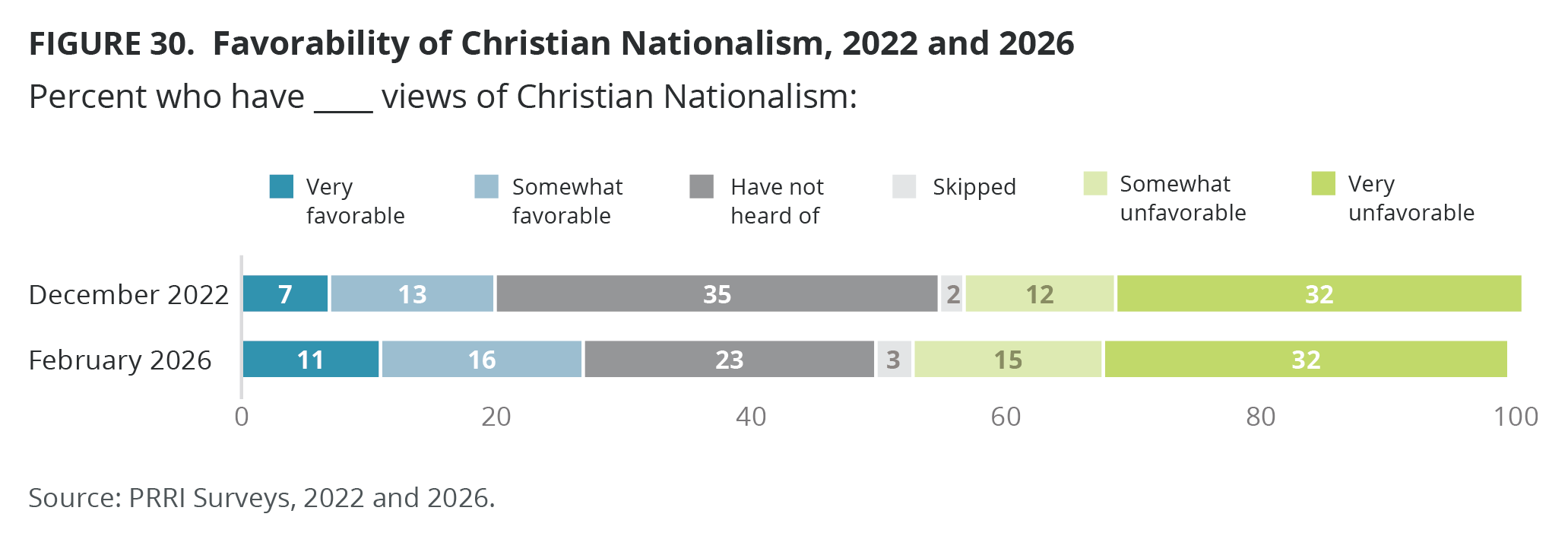
First, some context. The term “Christian nationalism” is not popular among the public. Overall, just 27% of Americans hold a favorable view of the term “Christian nationalism,” compared with 47% who hold an unfavorable view. About one quarter of Americans (23%) have not heard of this term.
The terms is also becoming more familiar to the public. Significantly fewer Americans have not heard of the term “Christian nationalism” today, compared to when we first asked about the term in 2022 (down 12 points from 35%). Compared to four years ago, the percentage who hold an unfavorable view of the term is up only 3 points (from 44%), while the percentage who who hold a favorable view is up 7 points (from 20%).
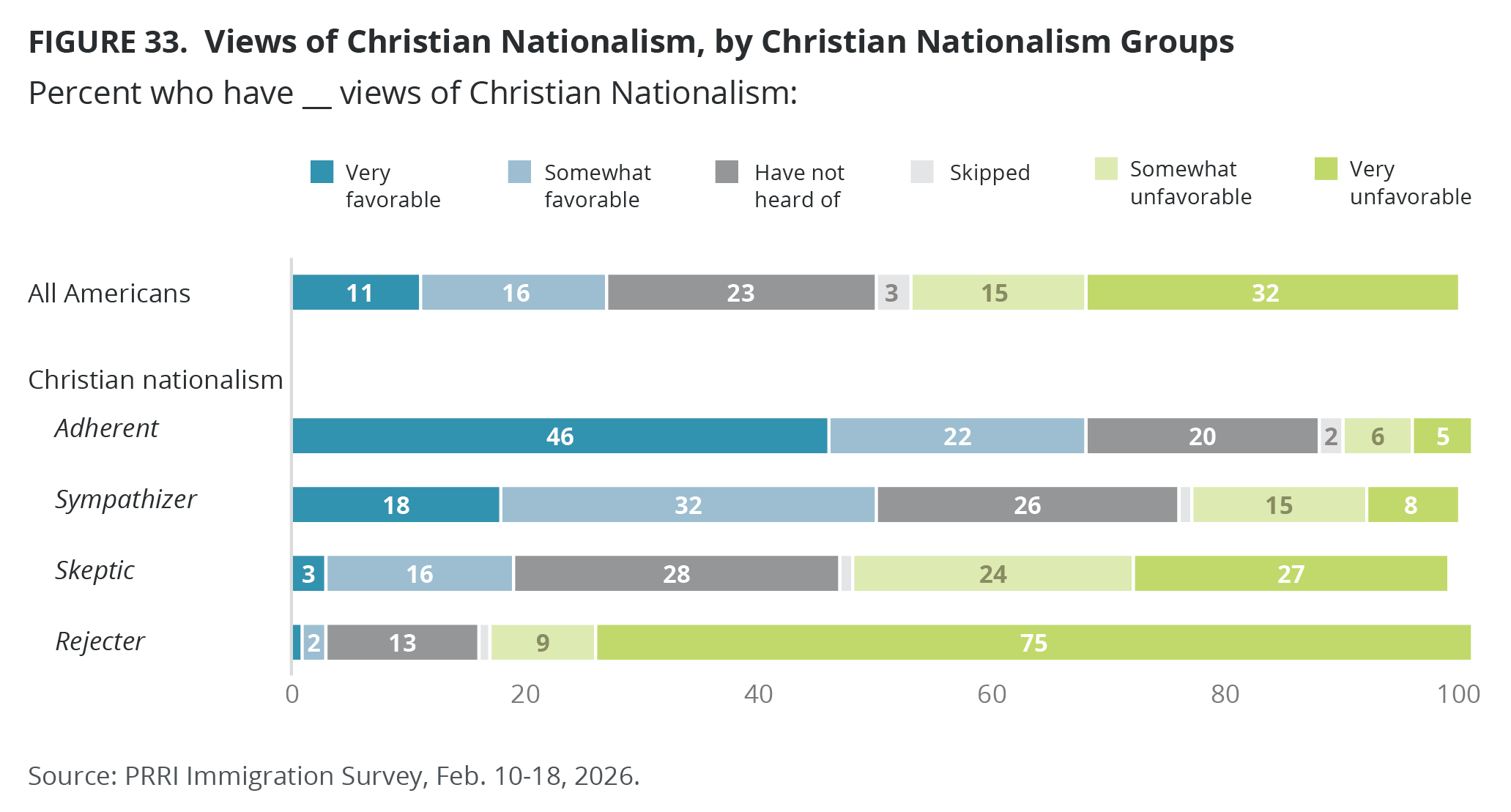
Notably, Americans who qualify as Christian nationalists using independent criteria are more likely than others to hold a favorable view of the term. Two-thirds of Christian nationalism Adherents (68%), as well as half of Sympathizers (50%) hold a favorable view of the term “Christian nationalism.” Morevover, while one quarter of Sympathizers say they are unfamiliar with the term, they are nearly twice as likely to hold positive than negative views of it. By contrast, only 19% of Christian nationalism Skeptics and 3% of Rejecters hold a favorable view of the term “Christian nationalism.”
Skeptics (28%) and Sympathizers (26%)—groups in the middle of the scale—are more likely than Adherents (20%) or Rejecters (13%) to say they have not heard of the term.
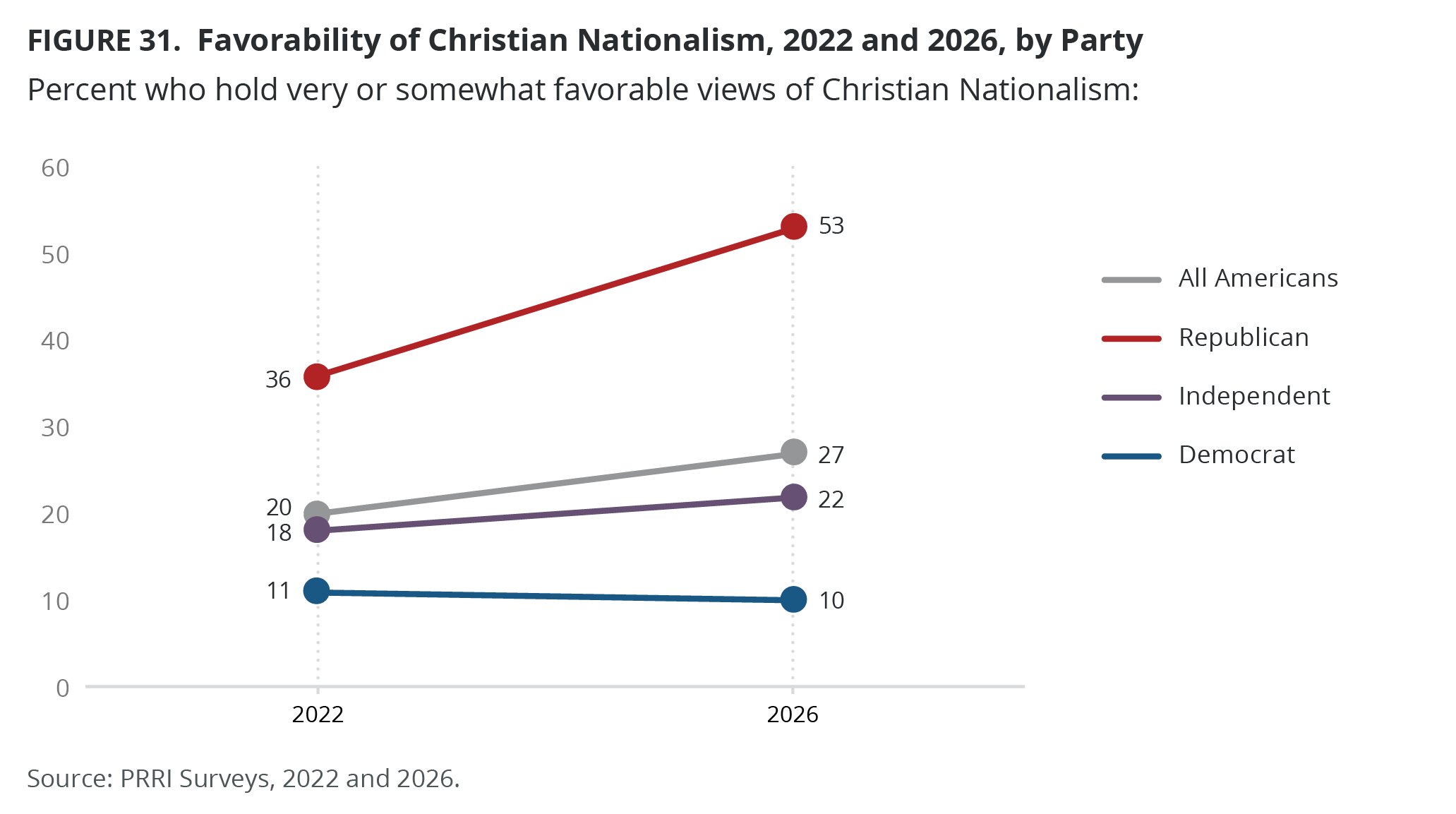
Most Republicans Now Hold a Favorable View of Christian Nationalism
Partisan divides remain stark: A majority of Republicans (53%) view Christian nationalism favorably, compared with 22% of independents and only 10% of Democrats. While support among independents and Democrats has remained relatively stable since 2022, Republicans are increasingly embracing the term, with favorable views rising a remarkable 17 points, from 36% to 53%.
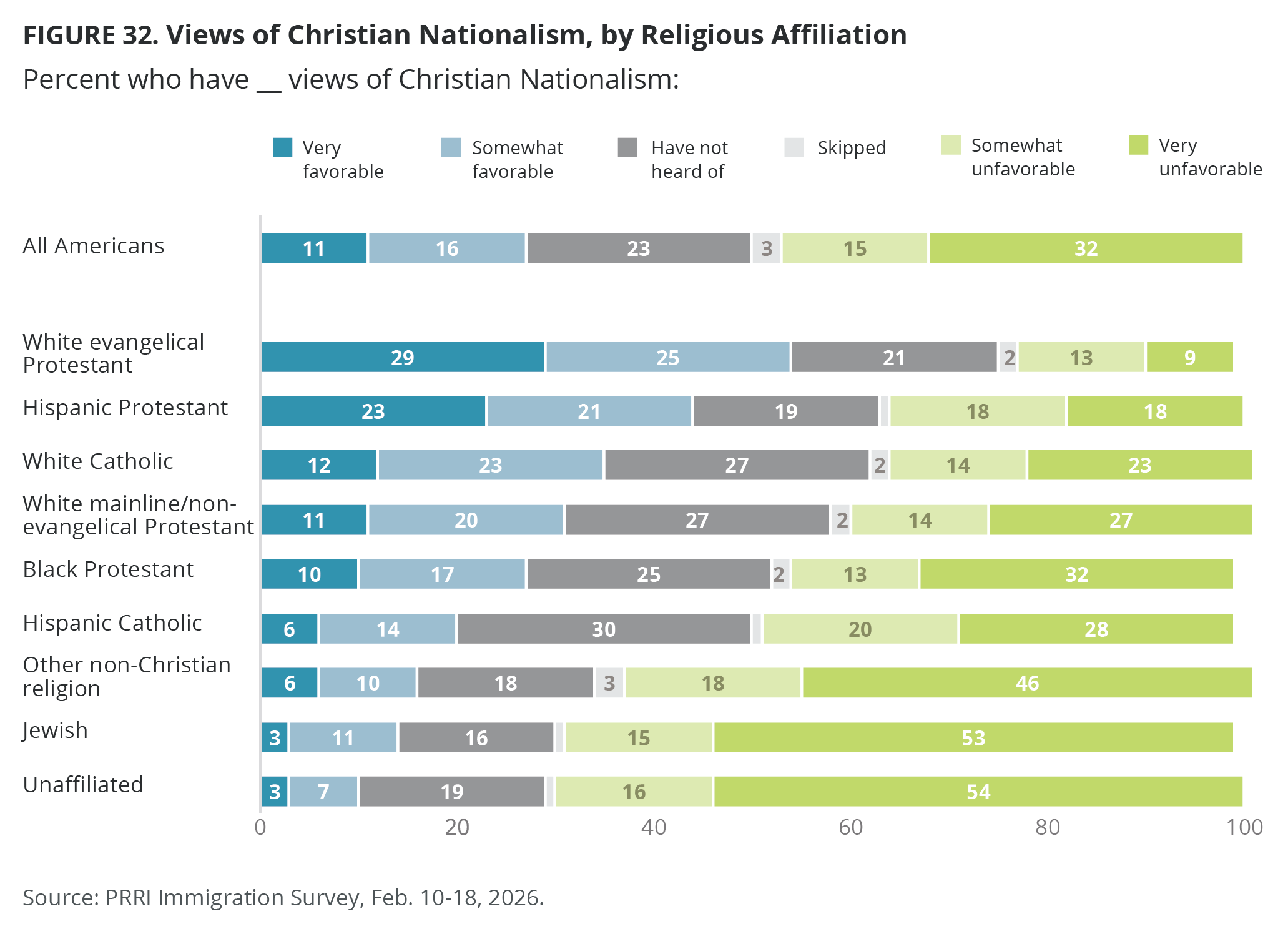
White evangelical Protestants are the only religious group in which a majority hold a favorable view of the term “Christian nationalism” (54%). Hispanic Protestants—a group that is majority evangelical in orientation and supported Trump in the 2024 election—also hold a favorable view of the term. Favorability of the term “Christian nationalism” is significantly lower among all other religious groups and among the religiously unaffiliated.
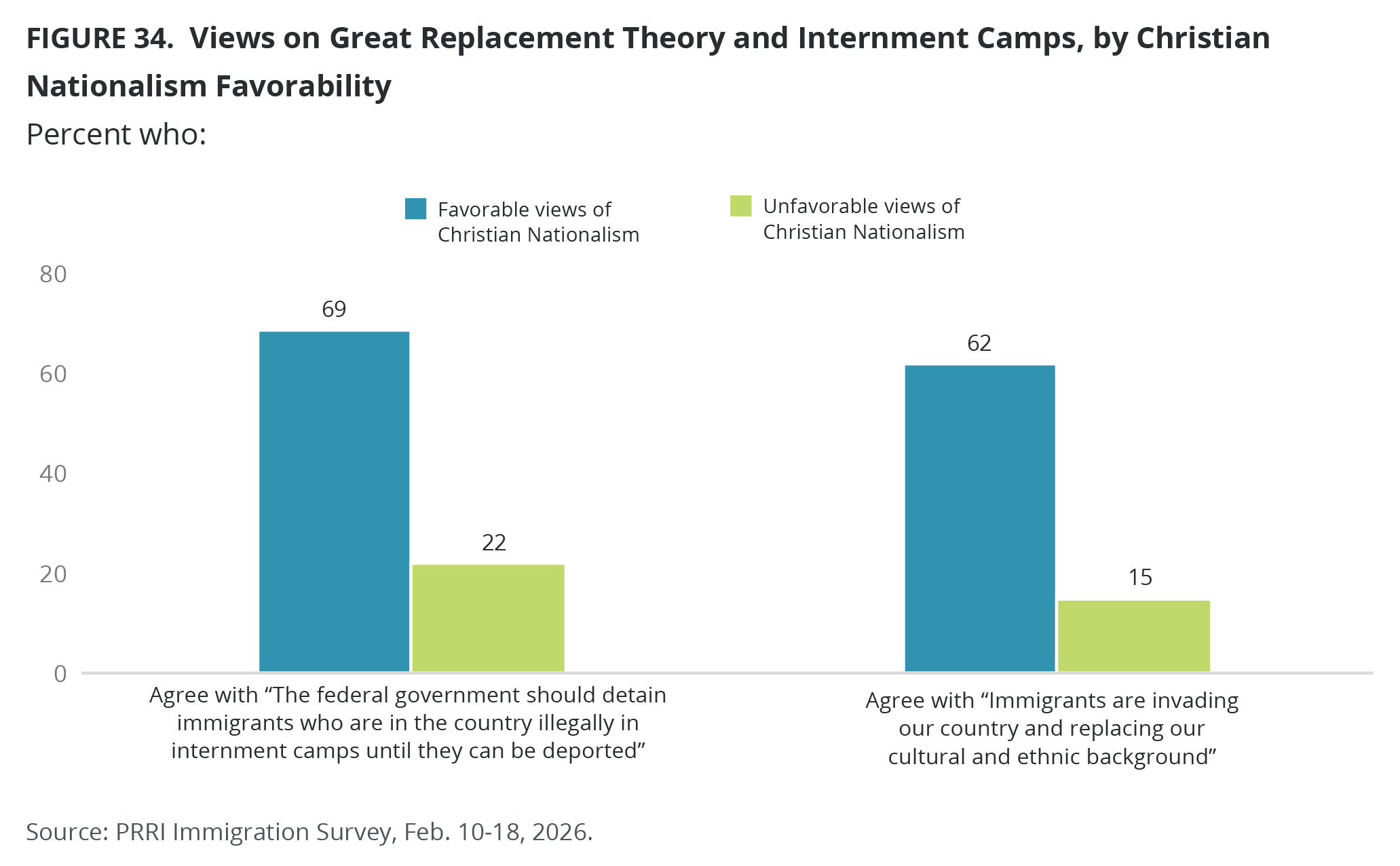
Holding a favorable view of the term “Christian nationalism” is strongly correlated with holding racist conspiracy theories toward immigrants and support for concentration camps on U.S. soil.
This analysis also dispels one of the leading objections to concerns about Christian nationalism: that those who affirm Christian nationalism are merely expressing support for a strong role for Christianity in public life. But this survey demonstrates that holding a favorable view of the term “Christian nationalism” is strongly correlated with embracing racist views about immigrants and harsh immigration policies. Here are just two examples.
Among those who hold a favorable view of the term “Christian nationalism,” 62% agree with the racist “great replacement theory,” that immigrants are invading our country and replacing our cultural and ethnic background, compared with only 15% of those who hold an unfavorable view of the term.
Similarly, among those who hold a favorable view of Christian nationalism, 69% agree that the federal government should detain immigrants who are in the country illegally in internment camps until they are deported, compared with only 22% of those who hold an unfavorable view of the term.
As I argue in my forthcoming book, BACKSLIDE, we cannot afford to be passive about the clear implications of this research. Despite the objections of some white evangelical apologists, Christian nationalists—both those who embrace the worldview and the term—endanger not only the moral integrity of Christianity but the future of America as a pluralistic democracy.


Thank you for posting this. Ugh
Really appreciated your discussion with Greg Sargent in The Daily Blast today 14.4.26!!!