

Mapping Christian Nationalism in All 50 States
Plus a 25% discount on new paid annual subscriptions through end of February

Just ahead of President Trump’s first State of the Union speech next week, PRRI has released a massive new study mapping support for Christian nationalism, demonstrating the extent to which this anti-democratic worldview has become entrenched across all 50 states.
I give my take on the key findings below. You can also watch my presentation of the data at our launch event below, which features a discussion between me, Ruth Ben-Ghiat , Melissa Deckman , and Bryan Massingale.
Flagging: I’m currently offering a 25% discount on new paid annual subscriptions through end of February. Details below.
Based on interviews with more than 22,000 adults conducted throughout 2025, the PRRI American Values Atlas finds that nationwide less the one third of Americans qualify as either Christian nationalism Adherents (11%) or Sympathizers (21%). By a margin of two to one, most Americans reject this worldview.
However, this minority worldview has come to have outsize public influence because it is the animating spirit of Trump’s MAGA movement, which has taken over the Republican party. Today, a majority of Republicans (56%) qualify as either Christian nationalism Adherents (21%) or Sympathizers (35%). This support contrasts sharply with the one in four independents (25%) and less than one in five Democrats (17%) who share these views.

The PRRI study also finds that white Christians (46%) are more likely than Christians of color (39%), non-Christians (13%), and religiously unaffiliated Americans (10%) to qualify as Christian nationalism Adherents and Sympathizers. White evangelical Protestants (67%) and Hispanic Protestants (54%)—two groups comprising the religious base of the Republican Party—are the only two major religious groups in which a majority qualify as Christian nationalism Adherents or Sympathizers.

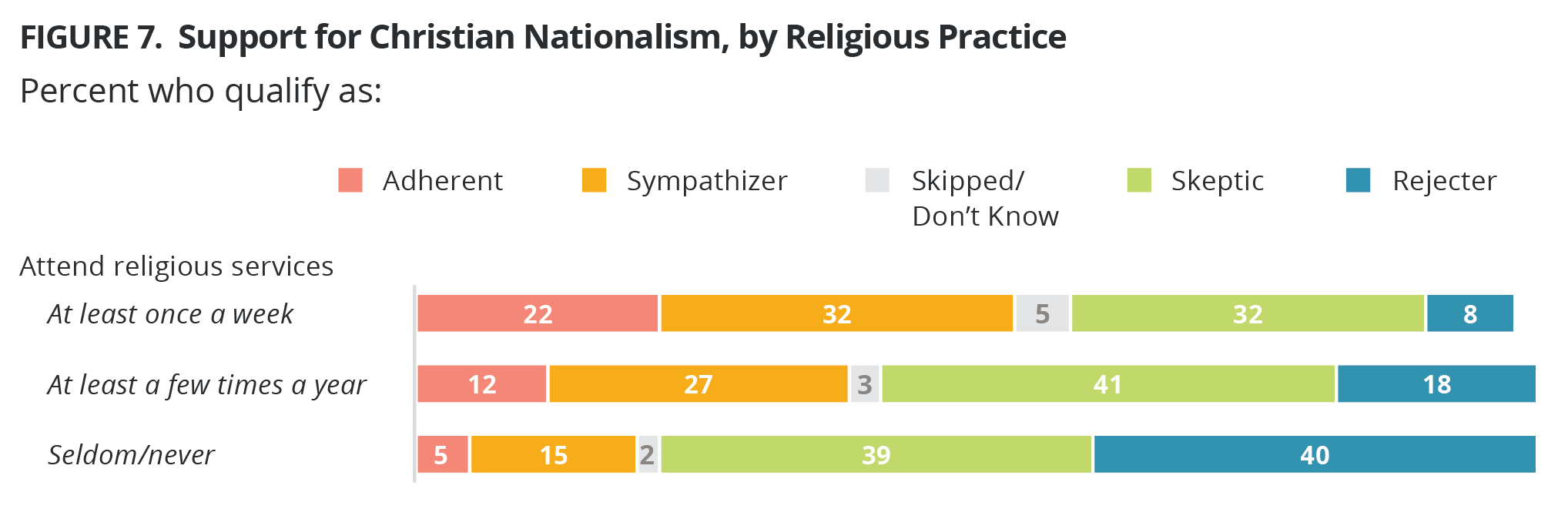
The study also definitively settles a question that has been the source of some debate: whether Christian nationalists are simply cultural Christians or “Christians in name only” (CINO), versus practicing Christians. The study’s findings are unequivocal. Support for Christian nationalism is positively correlated with a range of religious practices. In other words, on average, the more frequently Americans attend church, read the Bible, or pray outside of religious services, the more likely they are to hold Christian nationalist views.
The majority of Americans who attend religious services weekly or more qualify as Christian nationalism Adherents or Sympathizers (54%), compared with 39% of those who attend at least a few times a year and 20% of those who seldom or never attend religious services.
This correlation holds frequency of prayer and frequency of reading the Bible.
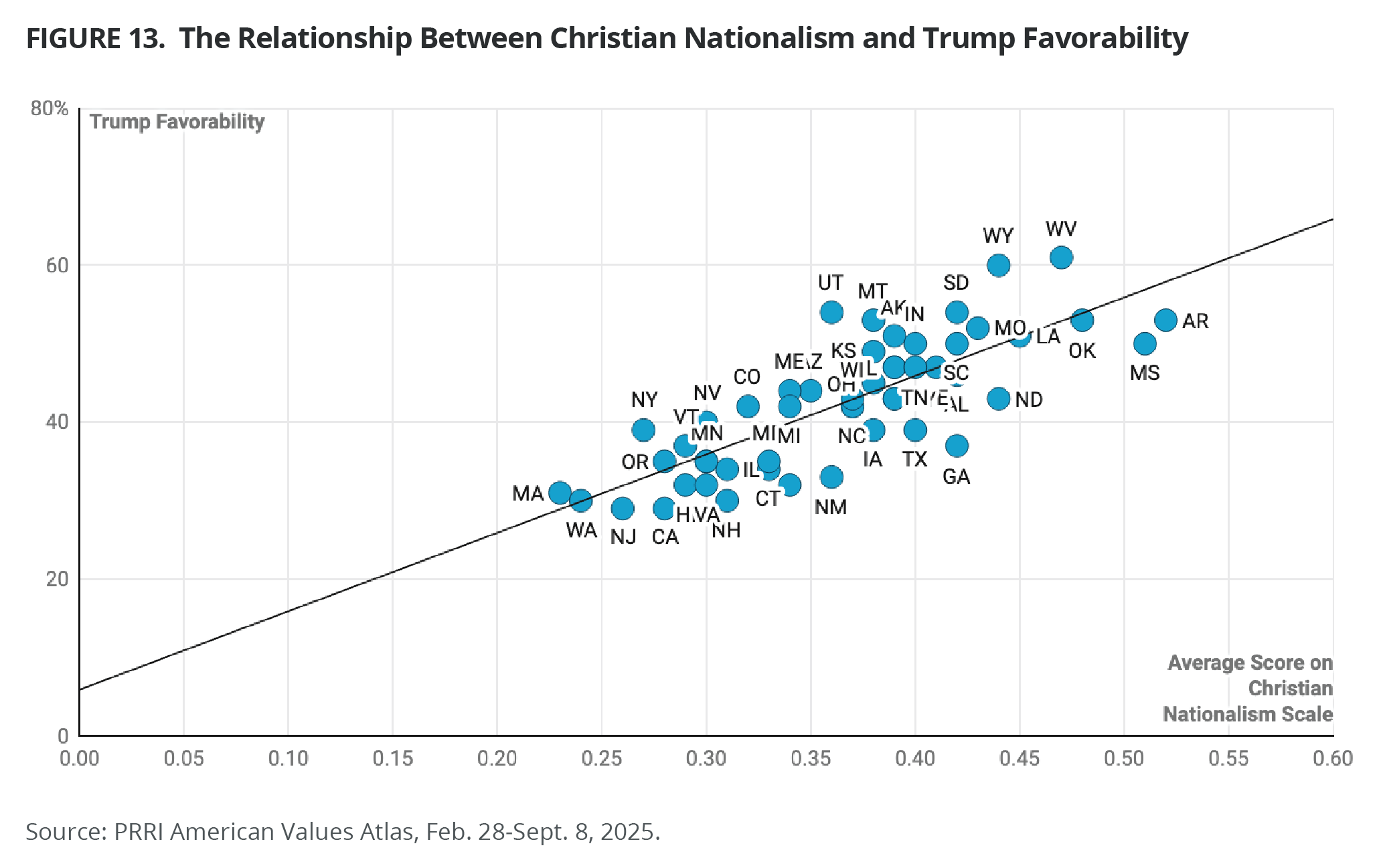
At the state level, Christian nationalist views predominate in the South and Midwest and are strongly correlated to both Trump favorability and Republican representation in state legislatures.
The states with the highest levels of support for Christian nationalism —about half of their residents — are Arkansas (54%), Mississippi (52%), West Virginia (51%), Oklahoma (49%), and Wyoming (46%). The higher a state’s residents score on the Christian nationalism scale, the more likely they are to hold favorable views of Trump and have a larger proportion of Republican elected officials in their state legislature.

If anyone doubts how central this worldview of Christian nationalism is to Trump’s MAGA movement, this scatterplot showing the linear correlation between state residents’ average score on the Christian Nationalism Scale and favorable views of Trump should settle them.
Other notable findings:
Political violence. Christian nationalism Adherents (30%) are more than twice as likely to agree that “true American Patriots may have to resort to violence” than Christian nationalism Skeptics (14%) and Rejecters (11%).
Trump as a dangerous dictator. Christian nationalism Adherents and Sympathizers overwhelmingly view Trump as a strong leader, while Skeptics and Rejecters overwhelmingly view him as a dangerous dictator.
Harsh and racist views of immigrants. Majorities of Christian nationalism Adherents (67%) and Sympathizers (53%) agree with the idea that “immigrants are invading our country and replacing our cultural and ethnic background,” compared with 32% of Skeptics and 8% of Rejecters. Additionally, majorities of Christian nationalism Adherents (61%) and Sympathizers (54%) support “the U.S. government deporting undocumented immigrants to foreign prisons without due process.” In contrast, around one-third of Skeptics (34%) and one in ten Rejecters (11%) agree.
There is much, much more in the full report.
**NOTE: I’m also inviting everyone to join my ongoing “Confronting White Christian Nationalism” series with Joy-Ann Reid , which airs on the third Wednesday of each month at 7 pm ET. You can check out the first four episides here.
A 25% Discount for February
To mark the renaming of my newsletter, I’m offering a 25% discount on new annual paid subscriptions to Redeeming Democracy through the end of February. Click below to subscribe.
Your paid subscription helps sustain my work, keeps most content free for everyone, and gives you full access to the following:
Weekly analysis and original writing, including previews of upcoming work;
Participation in the comments section with a lively community;
Substack+LIVE video conversations on breaking news with thought leaders;
Monthly author salon webinars; and
Five years of archives.
It also represents your commitment to support unflinching writing and analysis on religion and democracy. That’s never been more critical.
*Note: If you’d like to receive the benefits of being a paid subscriber but have been laid off or furloughed because of the Trump administration’s attack on our government, or otherwise cannot afford it, drop me a note at robertpjones.substack@pm.me and I can arrange a complimentary paid subscription).
Do you believe that candidates like James Talarico can significantly impact the sympathizers in your study. How will we know if and when it happens?
I watched the webinar on the new data. Really well done. Thank you.