

How Trump's Fight with Pope Leo XIV May Hurt Republicans in the Midterms
Reminder: Catholics are NOT white evangelicals.

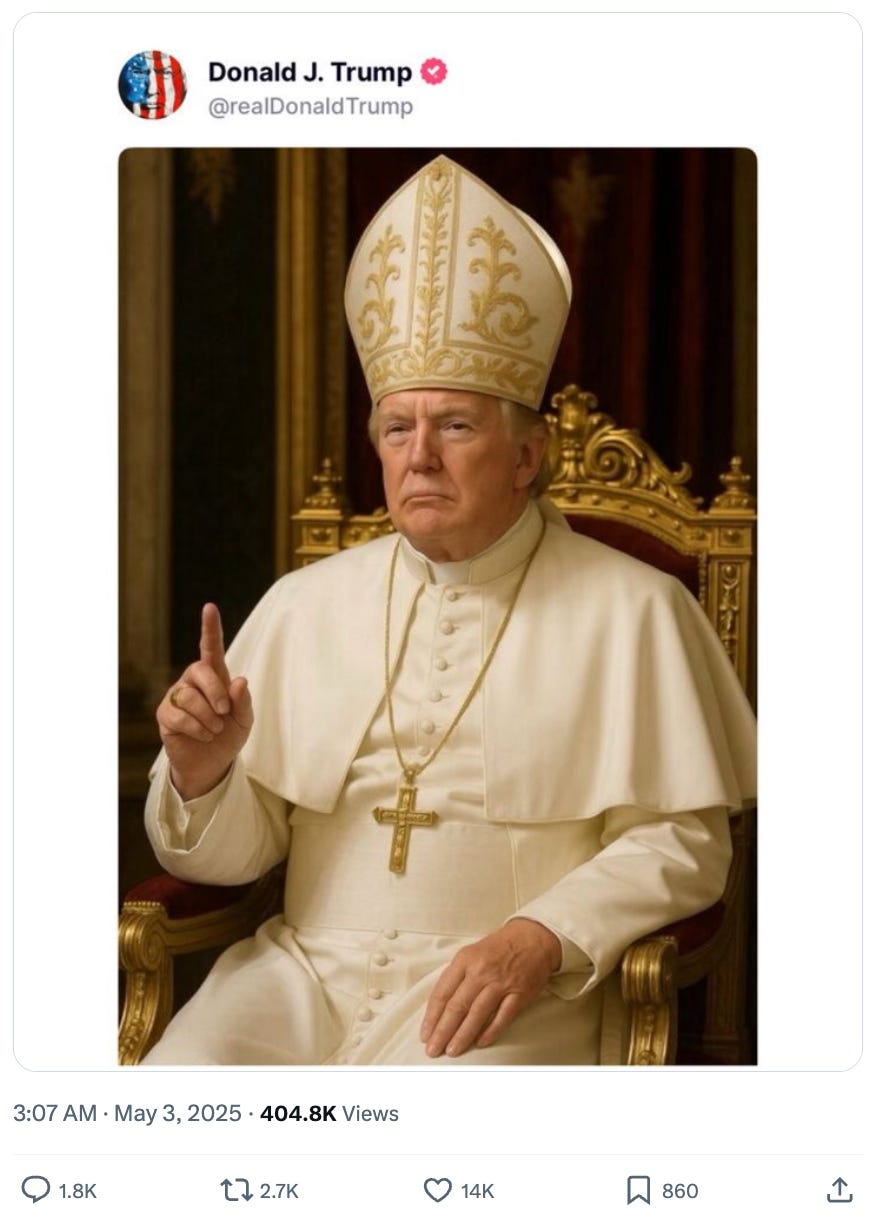
Wow, it’s been a busy two weeks of interviews (CNN, NPR, The New Republic, Financial Times, WIRED, National Journal, The Contrarian , The Joy Reid Show ), providing analysis and commentary on the various ways the Trump administration has distorted religion to justify an immoral war of choice with Iran. On parallel channels, we’ve witnessed Hegseth’s dangerous holy war rants, Vance’s arrogant lecturing Pope Leo XIV on Catholic theology, and Trump’s direct attacks on the pope, followed by an unhinged promotion of an AI image of himself as Jesus.
Quick Reminder: My new book, BACKSLIDE: Reclaiming a Faith and a Nation after the Christian Turn Against Democracy, is now available for pre-order. Please consider placing an order now, which helps enormously with new books. If you order via these links, part of your purchase goes to support this newsletter.
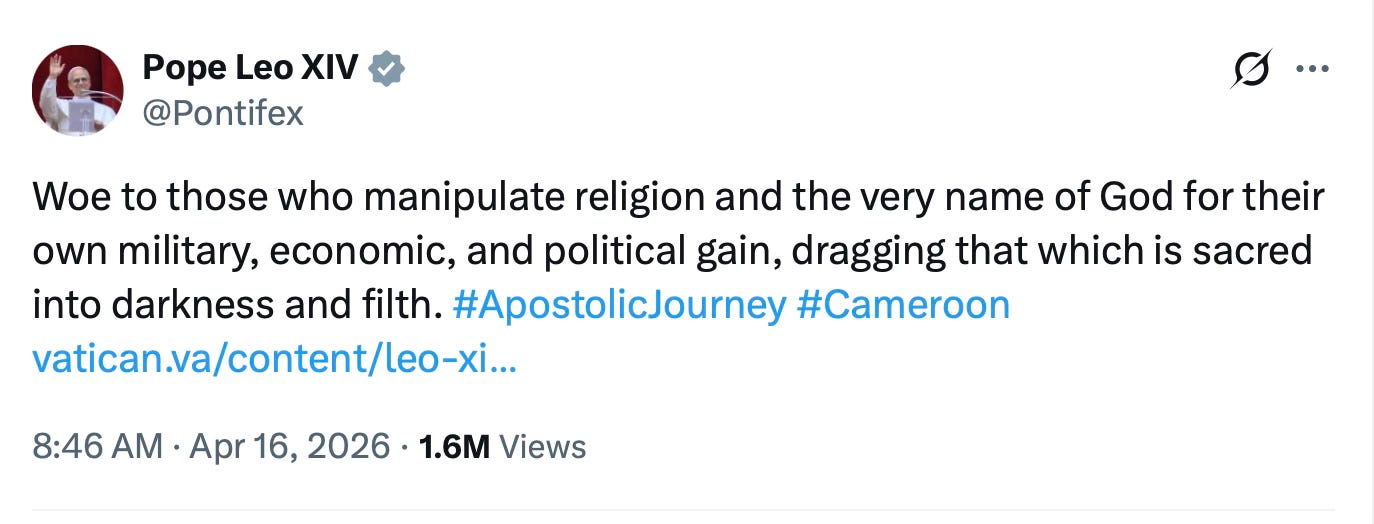
I’m sharing two podcasts below, along with some analysis of the potential political fallout from these distortions of religion. But first, I want to highlight the latest from Pope Leo. Even as Trump criticizes him—calling him “weak on crime” of all things—Pope Leo continues to call out the core problem: the sullying of religion in a quest for power.
My Conversation with Brian Lehrer on NPR/WNYC:
How Trump’s Self-Depiction as Jesus Lands with Christians
SHOW DESCRIPTION: In a now-deleted social media post, President Donald Trump shared an AI-generated image depicting himself as Jesus. He has also recently attacked Pope Leo XIV. Vice President JD Vance, meanwhile, has said that the pope should “be careful” when talking about theology. Robert P. Jones, president and founder of Public Religion Research Institute and author of the Substack newsletter Redeeming Democracy and the forthcoming book Backslide: Reclaiming a Faith and a Nation After the Christian Turn Against Democracy (St. Martin’s, 2026), talks about the range of responses from Christians.
Note: Full transcript is also available when you click through using the button below.

My Conversation with Greg Sargent at The New Republic:
Trump Erupts in Rage as Pope’s Harsh New Rebuke Lands Surprise Blow
SHOW DESCRIPTION: Donald Trump is furious at Pope Leo. After the pope sharply criticized the war on Iran, Trump exploded in a wild Truth Social rant, slamming the pope as “WEAK on crime” and clueless about the Iranian nuclear threat. Trump then posted an image of himself as Jesus, which he took down after MAGA figures lashed out at him. Trump then angrily insisted he had no idea that image had religious significance, and seethed some more over the pope’s criticism.
In today’s episode, Robert Jones, the president of the Public Religion Research Institute, makes a fascinating point: The pope’s criticism of his war appears calibrated in a way that could stir concern and debate about the war in many local churches at a grassroots level. That’s a hidden problem for Trump, says Jones, author of several books about religion and the American right. He explains why Trump’s spin will make this worse among religious voters, why all this will resonate more deeply with Catholics than with Trump’s evangelical base, and why Catholics are a point of real vulnerability for him. Listen to this episode here. A transcript is here.

What’s the Political Risk of Trump’s Fight with Pope Leo?
I don’t believe President Trump understands the political risk of picking a fight with Pope Leo XIV. My best guess is that he believes that the unquestioning submission demonstrated by his fawning white evangelical followers exists among all of his Christian followers. But Catholics are not white evangelical Protestants.
While white evangelicals have voted more than 80% for Trump every time he has been on the ballot and have held strongly favorable views of Trump through every controversy and outrage over the last decade, Catholics have been more measured in their support. Most notably, there is a strong racial and ethnic divide among Catholics: six in ten white Catholics supporting Trump each time he has been on the ballot, but six in ten Latino Catholics have supported his Democratic opponents.
Even before Trump’s war of choice with Iran, Trump’s standing with American Catholics was shaky. In a PRRI survey prior to the U.S. attacks on Iran, Trump’s favorability among white Catholics was barely in positive territory (53%); his favorability among Latino Catholics was only 25%, down 12 percentage points from 37% just before the 2024 election.
In an IPSOS poll released last week, only 46% of white Catholics and 33% of nonwhite Catholics approved of the military strikes against Iran. And 64% of white Catholics and 75% of nonwhite Catholics supporting ending the Iran war, even if not all the goals were met.
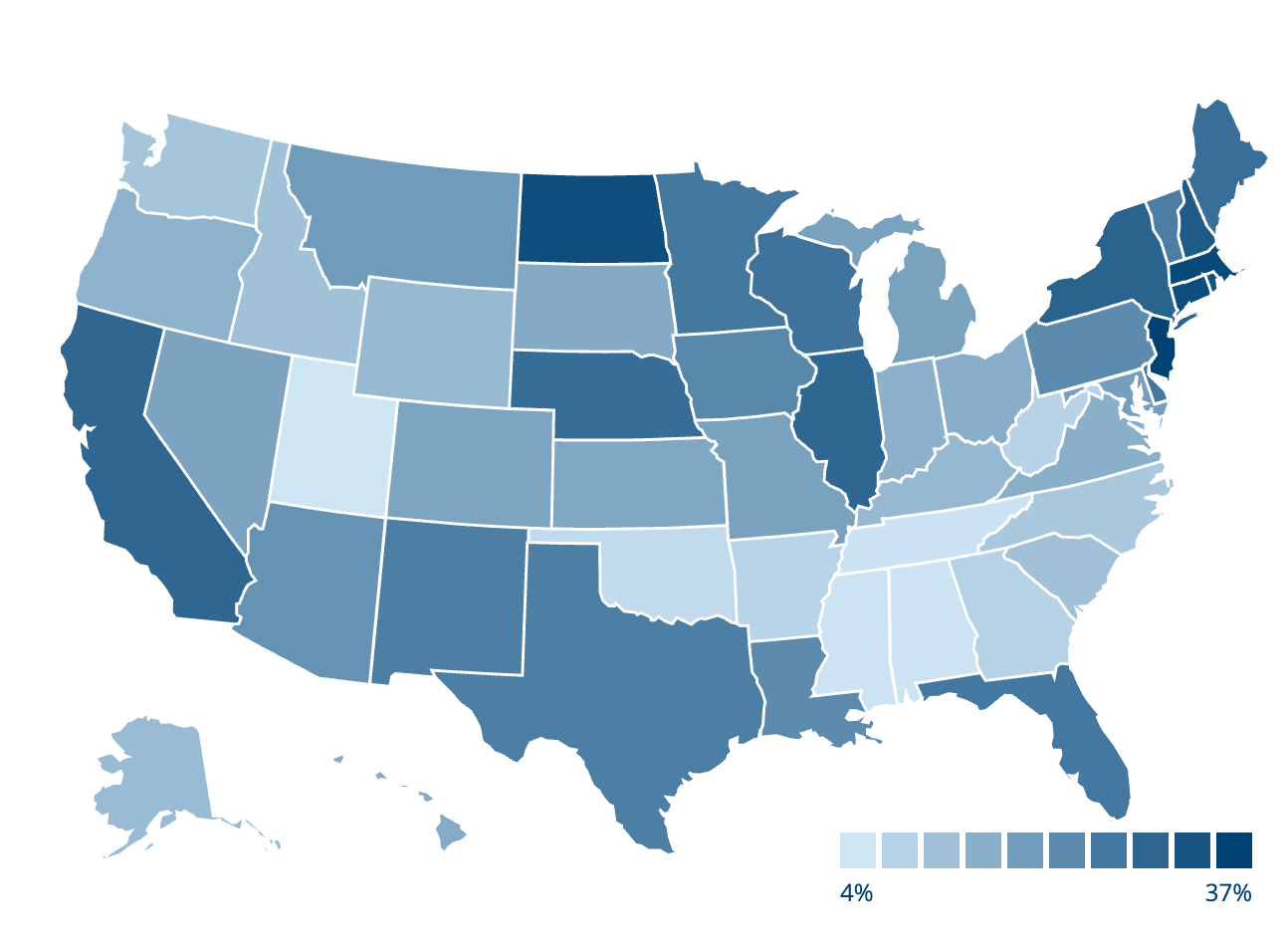
If his support falls further, it could be game over for Republican candidates in competitive midterm elections and for the next Republican presidential candidate. While Trump and Republican candidates might be able to weather a 5-10 point drop in support among white evangelical Protestants, given that they largely live in safe deep red districts and states, the GOP would not survive such losses among Catholics—both because of their size and their location. Overall, Catholics comprise 22% of Americans, nearly double the size of white evangelical Protestants (13%). Most importantly, Catholics are much more numerous in swing states, as this heat map illustrates (produced by PRRI’s interactive American Values Atlas, check it out for yourself!).
Take this one insight: Trump won the 2024 election by winning 62% of the white Catholic vote and 41% of the Latino Catholic vote. In 2020, when his support among white Catholics was 5 points lower and support among Latino Catholics 10 points lower, he lost the election.
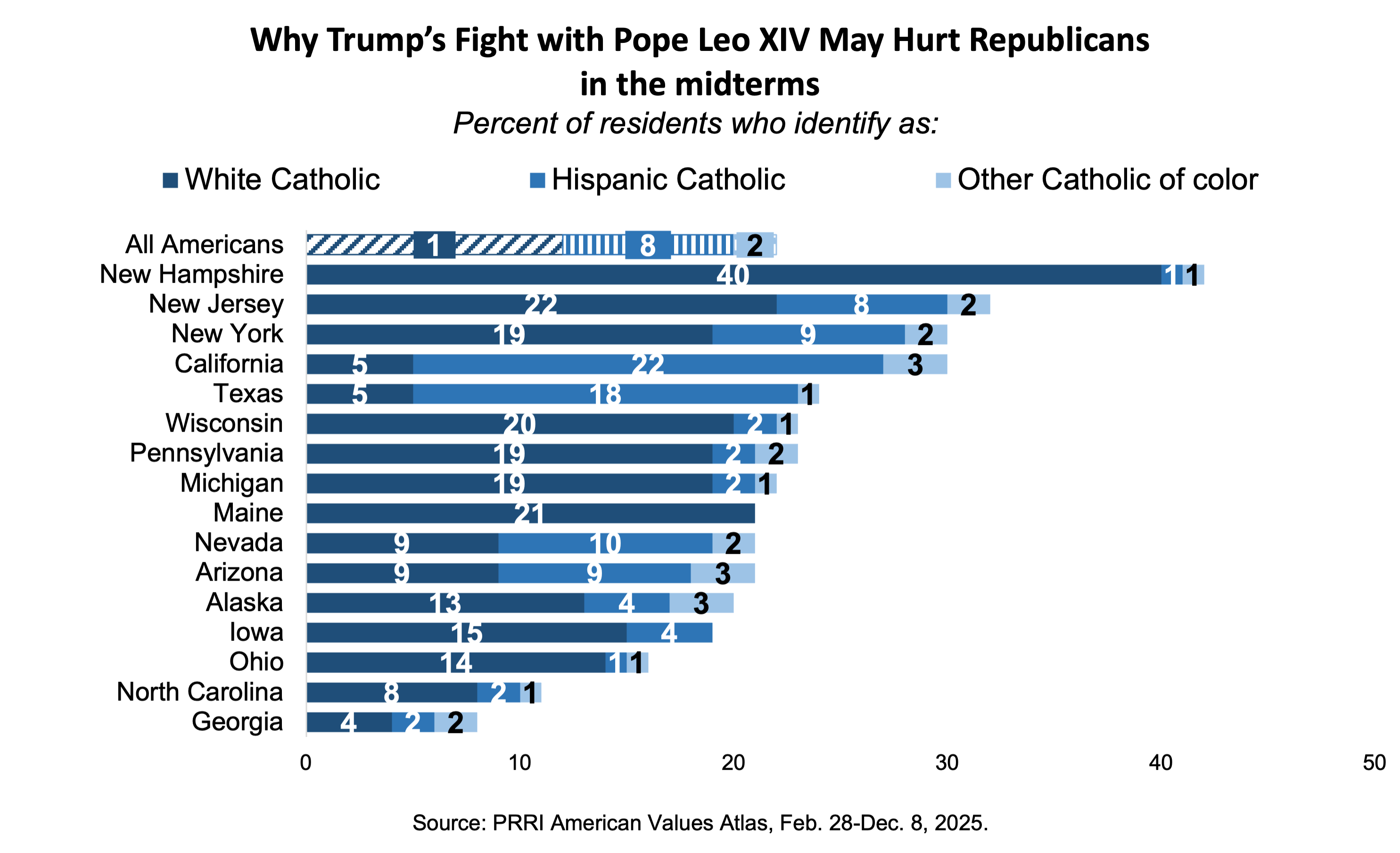
In the midterms elections, there are only a hand full of competitive races, and they are nearly all in states with significant Catholic populations. For example, the competitive House races are largely confined to Pennsylvania, Michigan, Wisconsin, New York, New Jersey, and Texas. Competitive Senate races are confined to Michigan, Maine, North Caroline, Georgia, Ohio, Alaska, and New Hampshire.
In these competitive states for the midterm elections, the Catholic vote looms large:
In 12 of these 16 states, Catholics comprise at least 20% of residents.
In 4 of these states, Catholics comprise at least 30% of residents.
In California and Texas, Hispanic Catholics (reminder: Trump favorability at 25%) outnumber white Catholics by around four to one.
In Nevada and Arizona, white Catholics and Hispanic Catholics are at parity.
As the ill-conceived war in Iran shows, Trump’s actions are guided by ego and the desire to dominate his opponents. Trump only thinks about consequences after they occur. For the midterms, the consequences are clear: a significant drop in Catholic support for Republican candidates from 2024 election levels would mean almost certain defeat. For those hoping to turn the country back toward a pluralistic democracy, these dynamics may be good news. By the time Trump feels the consequences of his feud with the pope, the power will have shifted.
The Daily Blast podcast thing in your post leads to a podcast with George Conway, not one with you.